Google has launched Gemini for Science, a powerful AI-driven research platform featuring tools like Hypothesis Generation, Computational Discovery, Literature Insights, and Science Skills. The initiative aims to accelerate scientific breakthroughs using advanced AI systems, including Co-Scientist, AlphaEvolve, ERA, and NotebookLM.
Gemini for Science: AI Experiments and Tools for a New Era of Discovery
Google has officially introduced Gemini for Science, a groundbreaking initiative designed to accelerate scientific research using advanced AI systems. Announced through Google Labs and integrated with Google’s latest AI technologies, this innovation aims to redefine how researchers explore hypotheses, analyze literature, and perform computational experiments.
With AI becoming an increasingly important force in scientific progress, Gemini for Science combines powerful models like Co-Scientist, AlphaEvolve, Empirical Research Assistance (ERA), and NotebookLM to support researchers across multiple scientific domains.
At Digital Addatech, we closely monitor the latest Google AI developments to help businesses, researchers, and technology enthusiasts stay updated with transformative innovations.
What is Gemini for Science?
Gemini for Science is a collection of AI-powered experiments and scientific tools created by Google to enhance the speed, precision, and scale of scientific discovery.
Google believes the future of research will not depend solely on narrow AI models but on intelligent AI agents capable of supporting researchers across different scientific disciplines.
The platform is designed to assist scientists in:
- Generating research hypotheses
- Conducting computational experiments
- Analyzing scientific literature
- Performing genomic and structural bioinformatics workflows
- Accelerating scientific validation processes
Why Gemini for Science Matters
Modern science faces a growing challenge: the amount of published research is expanding faster than any individual researcher can process.
Every year, millions of scientific papers are published globally. Discovering meaningful connections between datasets, theories, and experiments manually can take months.
Google’s Gemini for Science aims to solve this problem by acting as a force multiplier for human ingenuity.
Instead of replacing scientists, AI helps automate complex and time-consuming tasks so researchers can focus on high-impact discoveries.
Key AI Experiments in Gemini for Science
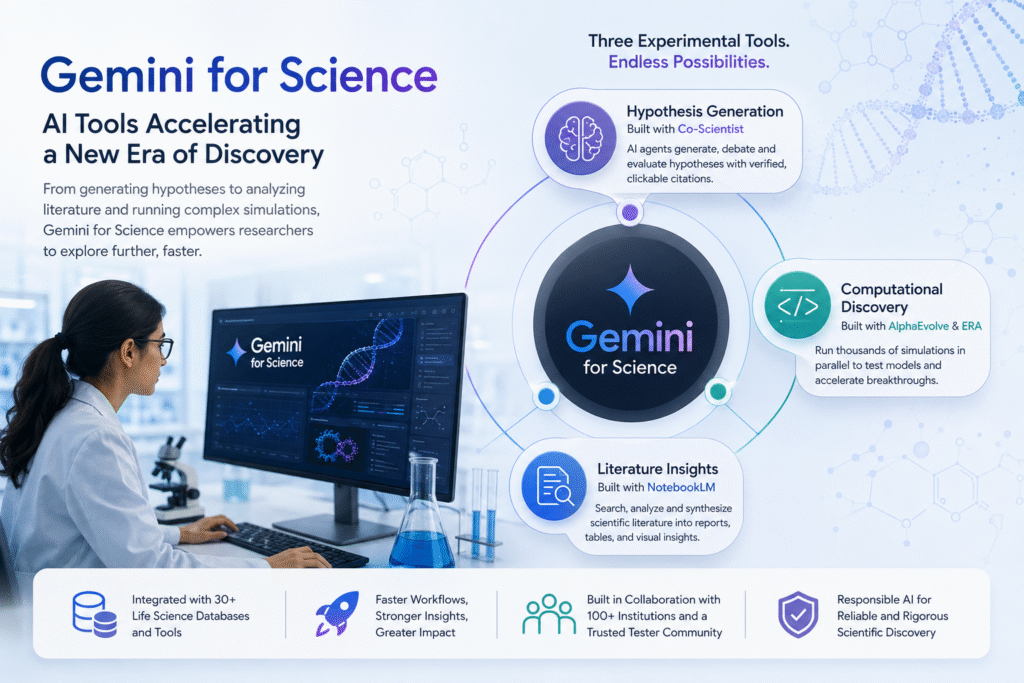
Google Labs introduced three major experimental tools under the Gemini for Science ecosystem.
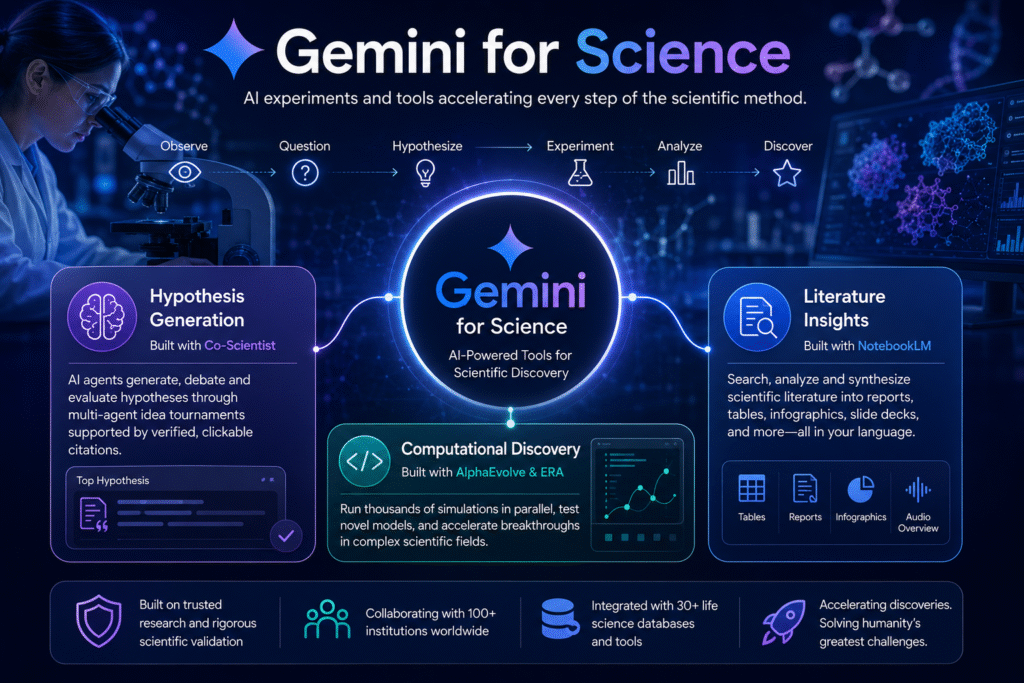
1. Hypothesis Generation (Built with Co-Scientist)
Scientific innovation begins with strong hypotheses. However, synthesizing insights from millions of research papers is impossible for humans alone.
How It Works:
- Researchers define a scientific challenge
- AI agents simulate the scientific method
- Multi-agent “idea tournaments” generate and evaluate hypotheses
- Claims are verified with clickable citations for transparency
Benefits:
- Faster idea generation
- Stronger evidence-backed hypotheses
- Reduced research bottlenecks
- Improved interdisciplinary discovery
This tool allows researchers to discover hidden patterns and innovative research directions much faster than traditional methods.
2. Computational Discovery (Built with AlphaEvolve & ERA)
Testing scientific hypotheses computationally often requires enormous time and resources.
What Computational Discovery Does:
- Generates thousands of code variations in parallel
- Scores and evaluates experimental models automatically
- Accelerates simulations in complex fields
Use Cases:
- Solar forecasting
- Epidemiology
- Advanced modeling systems
- Machine learning optimization
With Gemini for Science, experiments that once took months can now be explored in significantly less time.
3. Literature Insights (Powered by NotebookLM)
Understanding scientific literature is one of the most critical aspects of research.
Features:
- Searches and structures scientific literature
- Creates searchable research tables
- Allows side-by-side comparison of studies
- Generates reports, slide decks, infographics, and summaries
- Supports conversational research analysis
Advantages:
- Identifies research gaps
- Synthesizes findings quickly
- Simplifies literature reviews
- Improves knowledge discovery
Researchers can use NotebookLM’s AI-powered analysis to uncover hidden insights from large collections of scientific papers.
Science Skills: A Scientific Workbench on Desktop
As part of Gemini for Science, Google also introduced Science Skills, a specialized AI toolkit integrated with over 30 major life science databases and tools.
Integrated Platforms Include:
- UniProt
- AlphaFold Database
- AlphaGenome API
- InterPro
What Science Skills Enable:
- Structural bioinformatics workflows
- Genomic analysis
- Faster biological data interpretation
- Automated scientific workflows
Google reported that internal research teams reduced complex workflows from several hours to just minutes using Science Skills.
One early application helped uncover new insights into a rare genetic disease linked to mutations in the AK2 gene.
Enterprise Adoption of Gemini for Science
Google Cloud is already bringing these AI capabilities to enterprise organizations through private previews.
Companies Using Gemini for Science Technologies:
- BASF – Supply chain optimization using AlphaEvolve
- Klarna – Machine learning model enhancement
- Daiichi Sankyo – Accelerated pharmaceutical research
- Bayer Crop Science – Agricultural innovation
- U.S. National Labs – Scientific missions under the Department of Energy
These partnerships demonstrate how AI-driven scientific research is moving from experimentation into real-world impact.
Collaboration with the Scientific Community
Google emphasized responsible AI development by partnering with over 100 scientific institutions worldwide.
Collaborations Include:
- Stanford University
- Imperial College London
- The Crick Institute
- ICML
- STOC
- NeurIPS
Google also created a trusted testing community consisting of:
- PhD researchers
- Industry scientists
- Nobel laureates
These experts help validate AI-generated insights and ensure scientific reliability.
AI Research Papers Published in Nature
Google confirmed that validation research papers related to:
- ERA
- Co-Scientist
have now been published in the prestigious journal Nature.
This adds significant scientific credibility to the Gemini for Science initiative.
Gemini for Science and the Future of AI Research
Google’s long-term vision is to create AI systems that help solve humanity’s biggest scientific challenges.
The initiative builds upon previous innovations like:
- AlphaFold
- AlphaGenome
- Gemini Deep Research
- Earth Engine
- Google Scholar
- MedGemma
With the latest Gemini Deep Think advancements, Google continues to improve AI performance on highly complex scientific tasks.
Final Thoughts
The launch of Gemini for Science marks a major milestone in AI-powered research and scientific innovation.
By combining advanced AI models with collaborative scientific workflows, Google aims to:
- Accelerate discoveries
- Improve research efficiency
- Enhance scientific validation
- Enable breakthrough innovations across disciplines
As AI continues transforming industries worldwide, scientific research may become one of its most impactful applications.
At Digital Addatech, we will continue sharing the latest updates on Google AI technologies, digital innovation, and emerging trends shaping the future.
Frequently Asked Questions (FAQs)
What is Gemini for Science?
Gemini for Science is Google’s AI-powered scientific research initiative featuring tools for hypothesis generation, computational discovery, and literature analysis.
Which AI models power Gemini for Science?
The platform uses technologies like Co-Scientist, AlphaEvolve, ERA, NotebookLM, and Gemini Deep Think.
What are Science Skills in Gemini for Science?
Science Skills are AI-powered workflows integrated with life science databases for genomic and structural bioinformatics analysis.
Who can access Gemini for Science?
Google is gradually opening access through Google Labs. Researchers can register their interest at labs.google/science.
How does Gemini for Science help researchers?
It automates complex research tasks, accelerates literature analysis, improves hypothesis generation, and speeds up scientific workflows.